
Abraham Lincoln: Complete Biography and Presidential Legacy

Here’s a comprehensive and detailed historical overview of Abraham Lincoln, covering his early life, political career, presidency, Civil War leadership, assassination, and legacy.
Introduction
Abraham Lincoln: Complete History & Detailed Information
I. Early Life (1809–1830)
Birth and Family Background
Born: February 12, 1809
Location: Sinking Spring Farm, Hardin County, Kentucky (now LaRue County)
Parents: Thomas Lincoln (farmer and carpenter) and Nancy Hanks Lincoln
Siblings: Sarah Lincoln (sister), Thomas Jr. (died in infancy)
Early Hardships
Grew up in poverty; his family moved frequently due to land disputes.
Mother Nancy died in 1818 when Abraham was 9, likely from milk sickness.
His father remarried Sarah Bush Johnston, a widow who supported Lincoln’s education.
Education
Largely self-taught, had less than one year of formal schooling.
An avid reader—read the Bible, Aesop’s Fables, Shakespeare, and law books.
Known for storytelling, a love of learning, and strong moral character.
II. Early Career and Personal Life (1830–1846)
Move to Illinois
Family moved to Macon County, Illinois in 1830, then to Coles County.
Lincoln moved to New Salem, Illinois, where he worked as a store clerk, rail-splitter, and postmaster.
Black Hawk War (1832)
Served as a captain in the Illinois Militia during the brief conflict with Native Americans.
Gained early leadership experience but saw no combat.
Law and Politics Begin
Elected to the Illinois State Legislature (1834–1842) as a member of the Whig Party.
Studied law on his own and became a licensed attorney in 1836.
Practiced law in Springfield, IL, gaining a reputation as “Honest Abe.”
Marriage and Family
Married Mary Todd in 1842.
Children: Robert, Edward (died young), William “Willie” (died in the White House), and Thomas “Tad” Lincoln.
III. Congressional Career (1847–1849)
U.S. House of Representatives
Served a single term as a Whig Congressman from Illinois.
Criticized the Mexican-American War and President Polk.
Proposed the Wilmot Proviso, seeking to ban slavery in new territories (unsuccessful).
Did not seek re-election, returned to law.
IV. Return to Politics and Rise to National Prominence (1854–1860)
Kansas-Nebraska Act (1854)
Opposed the Act, which allowed new territories to decide on slavery through popular sovereignty.
Re-entered politics, helping to form the Republican Party, which opposed the expansion of slavery.
Lincoln-Douglas Debates (1858)
Ran for U.S. Senate against Stephen A. Douglas.
Held 7 famous debates, mainly on slavery.
Lost the election but gained national attention for his eloquence and anti-slavery stance.
“House Divided” Speech
“A house divided against itself cannot stand… I believe this government cannot endure permanently half slave and half free.”
V. Election to Presidency (1860)
Won the Republican nomination for president in 1860.
Opponents: Stephen A. Douglas (Northern Democrat), John C. Breckinridge (Southern Democrat), John Bell (Constitutional Union Party).
Won with only 39.8% of the popular vote but a majority in the Electoral College.
First Republican president.
His election triggered Southern secession.
VI. Presidency and the Civil War (1861–1865)
Secession and Civil War
South Carolina seceded in December 1860, followed by other Southern states.

Confederate States of America formed under Jefferson Davis.
Civil War began April 12, 1861, with the Confederate attack on Fort Sumter.
Leadership and Challenges
Initially focused on preserving the Union, not abolishing slavery.
Faced criticism from both abolitionists and pro-slavery factions.
Expanded executive power to deal with war, suspended habeas corpus in some cases.
Key Events During the War
First Battle of Bull Run (1861) – Union defeat, showed the war would be long.
Emancipation Proclamation (Jan 1, 1863) – Freed slaves in Confederate-held territories.
Gettysburg Address (Nov 19, 1863) – Redefined the purpose of the war and democracy.
“Government of the people, by the people, for the people, shall not perish from the earth.”
Battle of Gettysburg (1863) – Turning point, Union victory.
Ulysses S. Grant appointed General-in-Chief in 1864.
Re-election (1864)
Ran under the National Union Party with Andrew Johnson as VP.
Defeated Democrat George B. McClellan.
Victory boosted by Union military successes.
VII. Assassination (1865)
End of the War
Confederate General Robert E. Lee surrendered to Grant at Appomattox Court House on April 9, 1865.
Lincoln delivered his Second Inaugural Address weeks earlier, emphasizing reconciliation:
“With malice toward none, with charity for all…”
Assassination
Date: April 14, 1865 (Good Friday)
Location: Ford’s Theatre, Washington, D.C.
Assassin: John Wilkes Booth, an actor and Confederate sympathizer.
Lincoln died the next morning, April 15, becoming the first U.S. president to be assassinated.
Nation plunged into mourning.
VIII. Legacy
Major Achievements
Preserved the Union during its greatest internal crisis.
Abolished slavery with the 13th Amendment (passed December 1865).
Reshaped the nation’s moral and constitutional foundations.
Considered by many historians as the greatest U.S. president.
Memorials
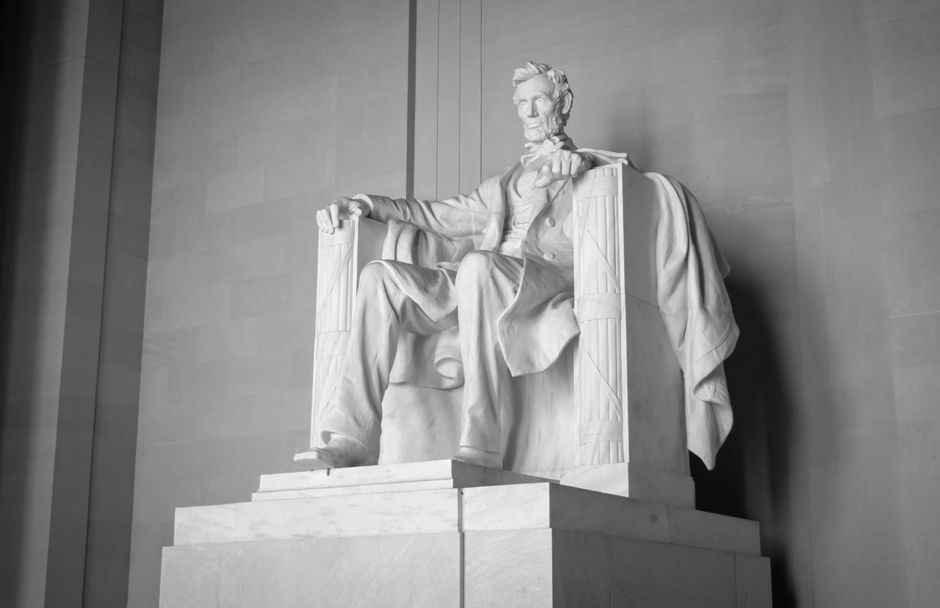
Lincoln Memorial in Washington, D.C.
Featured on the U.S. penny and $5 bill.
Countless schools, towns, and counties named after him.
Key Traits and Legacy Themes
Integrity & Honesty – “Honest Abe”
Oratory Skill – Famous for short, powerful speeches.
Moral Vision – Belief in liberty and human equality.
Resilience & Leadership – Led in the face of war, division, and personal loss.
Lincoln’s Political Philosophy & Vision
Lincoln’s presidency was shaped by a distinctive political philosophy that balanced pragmatism with moral conviction. His beliefs about the nature of democracy and the purpose of government fundamentally reshaped America. He rejected the Southern doctrine of secession, arguing that the Constitution created an indissoluble union. Lincoln believed government derived its legitimacy from the consent of the governed and that popular sovereignty—government of, by, and for the people—was democracy’s defining feature.
His views on equality evolved throughout his political career. Initially focused on preventing slavery’s expansion into new territories, Lincoln gradually came to embrace abolition as a moral imperative. The Gettysburg Address crystallized his vision: redefining the Civil War not merely as a battle for union preservation, but as a struggle for human equality and the survival of democracy itself.
Lincoln also pioneered the concept of executive war powers, expanding presidential authority to preserve the nation during crisis. His suspension of habeas corpus and military conscription set precedents for executive action in emergencies—decisions that remain controversial but reflected his conviction that extraordinary times require extraordinary measures to save the Republic.
His leadership style emphasized inclusion and pragmatism. Lincoln appointed rivals to his cabinet—the “Team of Rivals”—valuing dissent and diverse perspectives over ideological uniformity. This approach enabled consensus-building during America’s darkest hour, demonstrating that effective leadership sometimes requires accommodating political opponents for greater national purposes.
📧 Get More Insights Like This
Join thousands of readers who receive evidence-based personal development tips directly in their inbox.
🌟 Start Your Transformation Today
Ready to take the next step in your personal development journey?
Learn More About Us Browse All Articles