
Genghis Khan: Complete Biography, Military Strategy & Historical Legacy

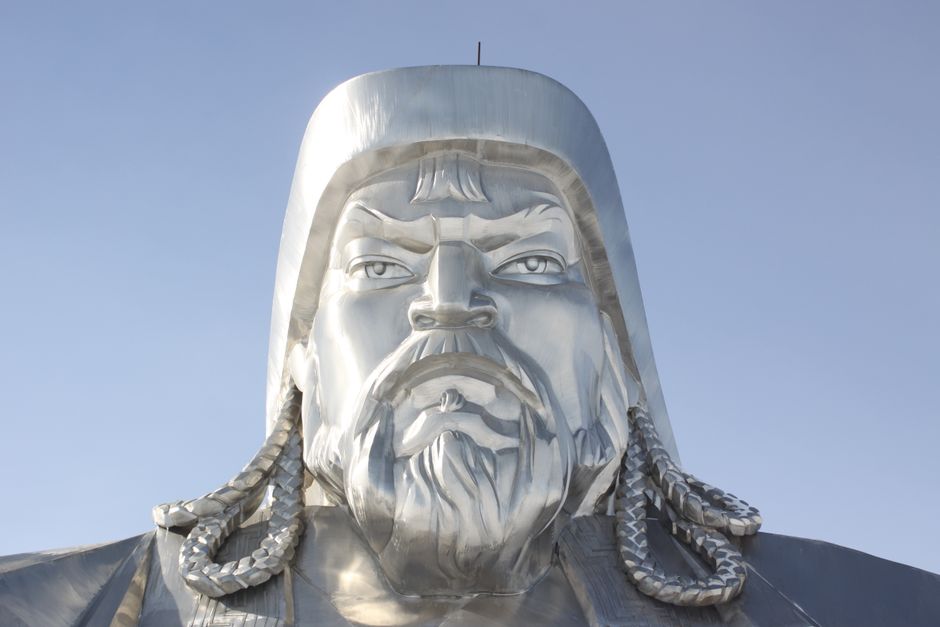
Genghis Khan: The Architect of the Largest Contiguous Empire in History
Genghis Khan (c. 1162–1227), born Temüjin, stands as one of history’s most transformative military leaders and empire builders. Rising from poverty and tribal obscurity to create the Mongol Empire—the largest contiguous land empire ever established—Genghis Khan fundamentally reshaped world history, politics, trade, and culture. His life represents an extraordinary arc from victimized youth to visionary leader whose achievements continue influencing our world nearly 800 years after his death.
Early Life: From Hardship to Ambition
Birth and Family Background
Temüjin was born around 1162 near the Onon River in present-day Mongolia. His father, Yesügei, was a minor tribal chief of the Borjigin clan—a small Mongol family lacking significant power or prestige. His birth name, Temüjin, literally means “the finest steel,” perhaps reflecting his father’s hopes for his son’s strength and resilience.
The Mongol steppes of his birth were characterized by:
- Constant tribal warfare over grazing lands and resources
- Nomadic pastoralism dependent on herds of animals
- Clan-based loyalties often superseding broader unity
- Raids and counter-raids creating cycles of vendetta
- Harsh environmental conditions requiring adaptation and courage
Formative Tragedies
Temüjin’s childhood was marked by trauma that forged his character and ambitions:
Father’s assassination: When Temüjin was approximately nine years old, his father Yesügei was poisoned by rivals of the Tatar tribe. This tragic event left the family vulnerable and unprotected in a society where power derived from strength and warrior prowess.
Enslavement and captivity: Following his father’s death, the Borjigin clan abandoned the family, viewing them as a burden. Rival tribes captured and enslaved Temüjin, intending to eliminate a potential future threat. His survival of this captivity through intelligence and physical resilience demonstrated qualities that would define his leadership.
Hardship and deprivation: The young Temüjin experienced poverty, social rejection, and repeated loss. His best friend Jamukha, who would later become his greatest rival, was kidnapped by enemies. Every challenge reinforced his determination to create a society where loyalty, merit, and vision mattered more than birthright.
Rise to Power: From Tribal Chaos to Unified Leadership
Building Alliances and Reputation
Rather than accepting his marginal status, Temüjin systematically built a following through:
Demonstrated military skill: He gained reputation as a brave warrior and tactical innovator, winning battles against numerically superior opponents through strategy and surprise.
Loyalty and reciprocity: He rewarded followers generously, created personal bonds transcending tribal affiliations, and treated soldiers equitably rather than privileging aristocratic birth. This meritocratic approach attracted talented individuals tired of rigid tribal hierarchies.
Judicious alliances: Temüjin formed strategic partnerships with tribal leaders, most notably Toghrul Khan, a Kerait chief, and Jamukha, initially his ally before becoming his rival.
Military innovation: He introduced new tactical approaches emphasizing rapid mobility, coordinated cavalry movements, and psychological warfare rather than traditional tribal combat.
Consolidation of Mongol Tribes
By the early 1200s, Temüjin had consolidated power over previously fragmented Mongol tribes. This unification involved:
Incorporation of defeated peoples: Rather than simply destroying rivals, he integrated their peoples into his growing confederation, offering security and stable rule in exchange for loyalty.
Creation of meritocratic institutions: He appointed commanders based on ability rather than birth, establishing principles of advancement based on demonstrated competence.
Elimination of tribal customary law: He replaced the ad-hoc justice of tribal vengeance with formal legal codes, reducing cycles of violence and creating predictable governance.
Religious tolerance: Unlike contemporary leaders, Temüjin permitted religious freedom, allowing shamanism, Buddhism, Islam, and Christianity to coexist, reducing religious motivations for rebellion.
The Kurultai of 1206: Declaration as Genghis Khan
In 1206, at a kurultai (tribal assembly), Temüjin was formally proclaimed “Genghis Khan”—meaning “Universal Ruler” or “Oceanic Ruler” (suggesting boundlessness like the ocean). This event marked the official birth of the Mongol Empire and Temüjin’s transformation from tribal leader to visionary emperor.
At this moment, Temüjin ruled perhaps one million people—a significant achievement for the fragmented Mongol world, yet merely the beginning.

Military Genius: Conquests and Strategic Innovation
Revolutionary Military Tactics
Genghis Khan’s military success derived from several innovations that transformed medieval warfare:
Specialized cavalry units: Rather than treating cavalry as simple warriors, he organized coordinated cavalry units with specialized roles—light cavalry for reconnaissance and harassment, heavy cavalry for breakthrough attacks, mounted archers for sustained fire.
Composite bow mastery: Mongol mounted archers wielded powerful composite bows with remarkable accuracy from horseback, delivering devastating firepower against stationary defenders. The bow range and accuracy gave Mongols tremendous advantages.
Psychological warfare: Genghis Khan spread terror deliberately—cities that resisted faced complete annihilation, while those surrendering were spared. This reputation for overwhelming force encouraged peaceful submission, reducing costly sieges.
Communication systems: He established the Yam (postal relay system), enabling rapid communication across vast distances, allowing coordinated simultaneous campaigns impossible for contemporary armies.
Intelligence networks: Mongol scouts created sophisticated spy networks, gathering intelligence about enemy positions, resources, and vulnerabilities before engaging them.
Adaptation and flexibility: Unlike many commanders bound by tradition, Genghis Khan continuously adapted tactics to enemy strengths, employing siege warfare against fortified cities and mobile cavalry tactics against open-field armies.
Major Military Campaigns
The Western Xia Dynasty (c. 1205-1209): Genghis Khan’s first major campaign against the Tangut kingdom demonstrated his ability to conduct extended military operations against established states with organized armies and fortifications.
The Jin Dynasty (1205-1234): The prolonged conflict against northern China’s Jin Dynasty represented Genghis Khan’s most ambitious military undertaking. Through years of campaigning, his forces gradually conquered northern China, demonstrating capability against sophisticated military powers with advanced siege technology.
The Khwarezmian Empire (1219-1221): After the Khwarezmian Shah allegedly executed Mongol envoys, Genghis Khan launched a devastating retaliatory campaign, personally leading 200,000 troops across Central Asia, destroying cities like Bukhara and Samarkand. Contemporary accounts describe total annihilation of cities that resisted, with entire populations killed.
Persia and the Caucasus: Mongol forces advanced westward, bringing Persian territories under Mongol dominion and establishing territorial control throughout Central Asia.
Russian campaigns: Initial Mongol raids into Rus’ (present-day Russia and Ukraine) established Mongol overlordship, eventually leading to Mongol rule over Russian principalities for centuries.
Governance and Administration
Legal and Administrative Systems
Genghis Khan wasn’t merely a military conqueror—he was a visionary administrator:
The Yassa: He established the Yassa (or Yasak)—a comprehensive legal code establishing rules for warfare, trade, justice, and social conduct. This codified law represented an advancement over the customary tribal law it replaced, providing predictability and consistency in governance.
Postal and communication: The Yam system wasn’t simply for military purposes. It connected the empire, enabled trade and communication, and created administrative efficiency in governance across vast distances.
Religious freedom: Unlike medieval Christian or Islamic states, Genghis Khan permitted religious plurality, benefiting from reduced religious conflict and economic advantages of attracting diverse populations.
Universal writing system: He established a unified writing system (based on Uyghur script) for administrative purposes, enabling standardized record-keeping across diverse linguistic territories.
Economic development: Recognizing that prosperous subjects generated more taxes and resources, Genghis Khan encouraged trade, protected merchants, and rebuilt cities after conquests, creating commercial networks that would become famous as the Silk Road.
Death and Succession
Death and Burial Mystery
Genghis Khan died in 1227, likely from injuries sustained in battle or possibly from complications related to hunting accidents. The exact cause remains historically uncertain, though contemporary sources mention battle wounds and illnesses.
His burial location remains unknown to this day. Historical accounts suggest his body was transported to Mongolia and buried in an unmarked grave, either to prevent grave desecration or to honor his wish for anonymity.
Despite his death, the Mongol Empire continued expanding under his successors, reaching even greater territorial extent within decades.
Legacy and Historical Impact
Mongol Dynasties
Genghis Khan’s descendants established several major dynasties:
The Yuan Dynasty in China (established by his grandson Kublai Khan) The Ilkhanate in Persia The Golden Horde in Russia and Eastern Europe The Chagatai Khanate in Central Asia
These dynasties ruled for centuries, profoundly influencing their regions.
Historical Reassessment
Modern historians offer complex assessments of Genghis Khan:
Critics emphasize: His campaigns created massive death tolls, with some estimates suggesting millions died in the Mongol conquests. Cities were utterly destroyed; populations were enslaved or exterminated; cultural devastation accompanied military conquest.
Supporters highlight: His administrative innovations, his religious tolerance, his meritocratic principles (radical for his era), and his vision of unified governance across ethnic and cultural boundaries. He established peace and security (the Pax Mongolica) that enabled unprecedented trade and cultural exchange.
Contemporary relevance: Modern genetic studies reveal that Genghis Khan may have as many as 16 million male descendants alive today—approximately 0.5% of the world’s male population. This extraordinary biological legacy reflects both the breadth of his empire and the polygamous customs of Mongol rulers.
Conclusion
Genghis Khan transcends simple categorization as hero or villain. His life exemplifies how individual vision, military genius, and administrative innovation can fundamentally reshape world history. Rising from poverty and marginalization, he created an empire spanning from China to Eastern Europe, established legal and administrative systems enabling unprecedented coordination across continental distances, and promoted religious tolerance and meritocratic advancement centuries before these became mainstream values.
His campaigns brought devastation and death, yet also stability and commercial exchange that enriched Eurasian civilization. His administrative innovations influenced subsequent Asian dynasties. His life demonstrates how individuals can transcend circumstances, how vision can unify fragmented peoples, and how innovations in military and administrative strategy can reshape entire civilizations.
Nearly 800 years after his death, Genghis Khan remains one of history’s most influential figures—a testament to the enduring impact of visionary leadership, strategic innovation, and the capacity to imagine and build something unprecedented.
📧 Get More Insights Like This
Join thousands of readers who receive evidence-based personal development tips directly in their inbox.
🌟 Start Your Transformation Today
Ready to take the next step in your personal development journey?
Learn More About Us Browse All Articles