
The History, Message, and Teachings of Prophet Muhammad: A Complete Guide to His Life and Legacy
📚 Free PDF Book Download
Get our comprehensive guide on spirituality and religious understanding
Download Free PDF Book
Introduction: Understanding One of History’s Most Influential Figures
When we talk about figures who fundamentally reshaped human civilization, Prophet Muhammad stands among a handful of people whose influence transcends time, geography, and culture. Today, nearly 1.8 billion Muslims—roughly one-quarter of humanity—follow his teachings and consider him the final messenger of God. But even setting aside faith, historians recognize Muhammad as one of the most consequential leaders in human history.
This isn’t a story meant to convince you of anything. It’s an honest exploration of a man whose life journey continues to shape our world. Whether you approach this from curiosity, academic interest, or spiritual seeking, understanding Muhammad’s history, message, and teachings offers profound insights into human nature, leadership, and the search for meaning.
What made an orphan from the Arabian desert become the founder of a global civilization? What were his actual teachings, stripped of centuries of interpretation and debate? How did his message transform not just religion, but law, science, art, and social organization? These are the questions we’ll explore together.
Part One: The Historical Context — Arabia Before Muhammad
A Land of Contradictions
To understand Muhammad, we first need to understand the world he was born into. Sixth-century Arabia was a land of extremes. The Arabian Peninsula sat at the crossroads of great empires—the Byzantine Christians to the north, the Zoroastrian Persians to the east—yet remained fiercely independent, largely because no empire considered its harsh deserts worth conquering.
Arabian society revolved around tribal loyalty. Your tribe was your identity, your protection, your entire social reality. Blood feuds could last for generations. A single act of violence might trigger cycles of revenge that consumed entire clans. The concept of a unified Arabian identity simply didn’t exist.
The Religious Landscape
Religiously, pre-Islamic Arabia was remarkably diverse. Most Arabs practiced a form of polytheism, worshipping various gods and goddesses associated with natural phenomena. The Kaaba in Mecca housed 360 idols, each representing different tribal deities. Meccans had become the custodians of this religious center, turning it into a major pilgrimage site and commercial hub.
But there were other currents flowing through Arabian religion. Jewish tribes had settled in cities like Yathrib (later Medina) and maintained their monotheistic traditions. Christian communities existed in Yemen and the northern reaches of Arabia. Some Arabs, known as Hanifs, rejected idol worship and sought the religion of Abraham, believing in one God without committing to Judaism or Christianity.
This religious diversity would later become important—Muhammad’s message didn’t emerge in a vacuum but within a complex tapestry of existing beliefs.
The Social Reality
Pre-Islamic Arabian society was harsh, particularly for those without power. Women had few rights and were often treated as property. Female infanticide was practiced by some tribes who saw daughters as economic burdens. Slavery was widespread and brutal. The rich grew richer through trade and usury, while the poor had little recourse.
Yet there was also poetry, hospitality, and a code of honor. Arab poets were celebrities, their verses memorized and recited across the peninsula. Hospitality to travelers was considered sacred. Bravery in battle and loyalty to one’s word were supreme virtues. Understanding these values helps explain why Muhammad’s message would resonate—and why it would also threaten established powers.
Part Two: The Life of Muhammad — From Orphan to Prophet
Early Life and the Formation of Character (570-595 CE)
Muhammad was born around 570 CE in Mecca, into the Banu Hashim clan of the Quraysh tribe. His life began with tragedy. His father, Abdullah, died before Muhammad was born. His mother, Amina, died when he was just six years old. His beloved grandfather, Abdul Muttalib, who had taken him in, passed away two years later.
By eight years old, Muhammad was essentially alone in the world.
His uncle Abu Talib, who became his guardian, was kind but not wealthy. Muhammad had no inheritance, no special status, and little protection beyond his uncle’s care. In a society built entirely on tribal connections and family wealth, he started with almost nothing.
This orphaned beginning shaped Muhammad profoundly. Throughout his later teachings, orphans, widows, and the vulnerable would hold special importance. He knew what it meant to be powerless in a world that rewarded power.
As a young man, Muhammad worked as a shepherd and later as a trader. He earned a reputation for honesty so consistent that people called him “Al-Amin”—the Trustworthy. In a merchant society where deception was common, his integrity became his defining characteristic. People trusted him with their goods, their secrets, and their disputes.
Marriage to Khadijah and Years of Contemplation (595-610 CE)
At twenty-five, Muhammad’s reputation attracted the attention of Khadijah bint Khuwaylid, a wealthy merchant widow fifteen years his senior. She was a remarkable woman—successful in business, respected in society, and independent in spirit. Impressed by Muhammad’s character and competence, she proposed marriage.
Their partnership was extraordinary by any standard. For twenty-five years, until her death, Muhammad took no other wife. In a society where polygamy was normal and expected, particularly for men of status, this was unusual. By all accounts, theirs was a relationship of deep love, mutual respect, and genuine partnership.
Khadijah’s financial security gave Muhammad something rare: time for contemplation. He began retreating regularly to a cave called Hira on Mount Jabal al-Nour outside Mecca. There, away from the noise and commerce of the city, he would spend days in meditation and prayer, troubled by the moral corruption he saw in Meccan society.
What exactly he was seeking in those cave retreats, we can’t know with certainty. But the practice itself tells us something important: Muhammad was a searcher, a man dissatisfied with easy answers and comfortable assumptions. He questioned. He reflected. He struggled with big questions about meaning, morality, and truth.
The First Revelation (610 CE)
In 610 CE, during one of his retreats in the cave of Hira, something happened that would change everything. According to Islamic tradition, the angel Gabriel appeared to Muhammad and commanded him to “Read” (Iqra).
Muhammad was terrified. He was forty years old, illiterate, with no prophetic training or expectation. He reportedly fled the cave, shaking, and rushed home to Khadijah, crying “Cover me! Cover me!” He genuinely feared he was losing his mind or being possessed by spirits.
Khadijah’s response in this moment reveals her character and their relationship. She didn’t dismiss his experience or panic. Instead, she consoled him and took him to her cousin Waraqah ibn Nawfal, an elderly Christian scholar who had studied religious texts extensively.
Waraqah listened to Muhammad’s account and declared: “This is the same angel who came to Moses. I wish I could be alive when your people drive you out.” When Muhammad asked why he would be driven out, Waraqah explained that no one brings such a message without facing opposition.
The revelations continued, though sporadically at first. Muhammad received the Quran over twenty-three years, piece by piece, addressing situations as they arose. He would enter a distinctive state when receiving revelation—sometimes described as like the ringing of bells or tremendous weight—and afterward would recite the verses to his companions, who memorized and later wrote them down.
The Early Years of Preaching (610-622 CE)
For the first three years, Muhammad preached privately, gathering a small group of followers. His earliest converts were telling: his wife Khadijah, his young cousin Ali, his close friend Abu Bakr, and his freed slave Zayd. A wealthy woman, a child, a merchant, and a former slave—the message was reaching across social barriers from the beginning.
When Muhammad began preaching publicly, Meccan opposition intensified. His message threatened the religious establishment (and the profitable pilgrimage business), challenged the social hierarchy, and attacked the tribal identity built around ancestral gods.
The Quraysh tried various tactics: mockery, offers of wealth and power if he’d stop preaching, economic boycotts, and eventually physical persecution of his followers. Muhammad’s own uncle Abu Lahab became one of his fiercest opponents. Converts without tribal protection faced torture. Some, like Bilal, an African slave who became one of the first Muslims, were brutally tortured for refusing to renounce their faith.
In 615 CE, conditions became so dangerous that Muhammad sent a group of followers to seek refuge in Christian Abyssinia (modern-day Ethiopia). The Christian king there protected them, reportedly moved by the Quran’s respectful treatment of Jesus and Mary.
The Year of Sorrow and the Migration to Medina (619-622 CE)
619 CE brought devastating losses. Both Khadijah and Abu Talib died within months of each other. Muhammad lost his beloved wife of twenty-five years and the uncle who had protected him. Without Abu Talib’s tribal protection, the persecution intensified.
Muhammad sought new allies, traveling to the nearby city of Ta’if. The response was brutal—he was mocked, rejected, and stoned until his shoes filled with blood. In one of the lowest moments of his mission, he reportedly prayed not for revenge but for guidance and hoped that perhaps the descendants of those who rejected him might one day accept the message.
Then came an unexpected opening. Pilgrims from Yathrib, a city north of Mecca plagued by tribal conflict, heard Muhammad’s message and were intrigued. Over two years, a growing number of Yathrib’s citizens converted and invited Muhammad to come as an arbitrator and leader.
In 622 CE, facing a plot to assassinate him, Muhammad secretly emigrated to Yathrib—a journey known as the Hijra. This event was so significant that the Islamic calendar counts from this date, not from Muhammad’s birth or the first revelation. The community-building that followed, not just the prophetic call, was considered the true beginning.
Yathrib became known as Medina—short for “Madinat al-Nabi,” the City of the Prophet.
Part Three: Building a Community — The Medinan Period (622-632 CE)
The Constitution of Medina
One of Muhammad’s first acts in Medina was establishing a constitution—one of the earliest documented constitutions in human history. The Constitution of Medina was revolutionary in its scope.
It established a unified community (ummah) that included Muslims and non-Muslims alike. Jewish tribes were granted religious freedom and equal political rights. All signatories agreed to defend Medina together and submit disputes to Muhammad for arbitration. Tribal identity, while not erased, was subordinated to this new social contract.
This wasn’t a theocracy in the simple sense. The Constitution created a pluralistic society with Muhammad as the ultimate arbiter but with significant autonomy for different religious communities. It was a political solution as much as a religious one—and it worked, at least initially, to end the tribal warfare that had plagued Yathrib.
Conflicts and Growth (622-630 CE)
Peace with Mecca proved impossible. The Meccans saw Medina as a threat and began launching military expeditions. What followed were several years of intermittent warfare.
The Battle of Badr (624 CE) was a stunning Muslim victory against a larger Meccan force. The Battle of Uhud (625 CE) was a near-defeat that cost Muhammad dearly—including his uncle Hamza. The Battle of the Trench (627 CE) saw Medina besieged by a coalition of enemies but surviving through strategic defense.
These weren’t holy wars in the later crusading sense. They were survival conflicts with religious dimensions. Muhammad’s military leadership—pragmatic, strategic, and often merciful toward enemies—became part of his legacy, for better and worse in how later generations would interpret it.
The Treaty of Hudaybiyyah (628 CE) brought an unexpected turning point. Muhammad agreed to terms that seemed unfavorable, including postponing a pilgrimage to Mecca. Many followers were upset. But the peace allowed for two years of uninterrupted preaching, during which Islam spread dramatically. The treaty’s wisdom became apparent in hindsight.
The Conquest of Mecca (630 CE)
When Mecca’s allies violated the treaty, Muhammad marched on his hometown with an army of ten thousand. The conquest was remarkably bloodless. Rather than seeking revenge for years of persecution, torture, and warfare, Muhammad declared a general amnesty.
Standing at the Kaaba, he reportedly asked the Meccans: “What do you think I will do with you?” They responded: “You are a noble brother, son of a noble brother.” He replied: “Go, you are free.”
Even his most bitter enemies were pardoned. Hind, who had mutilated Hamza’s body after Uhud, was forgiven. The Kaaba was cleansed of its idols, and Mecca became Islam’s holiest city. This mercy at the moment of triumph became one of the most celebrated examples of Muhammad’s character.
The Final Years (630-632 CE)
The last two years of Muhammad’s life saw most of Arabia accepting Islam, either through conversion or political alliance. He continued teaching, arbitrating disputes, and receiving revelations.
In 632 CE, Muhammad performed his Farewell Pilgrimage to Mecca—the only full pilgrimage he would make as a Muslim. His sermon there summarized his life’s message. He declared all people equal regardless of race or ancestry. He emphasized the rights of women. He forbade usury and blood feuds. He proclaimed that Muslims were one brotherhood.
One passage from this sermon resonates across centuries: “All mankind is from Adam and Eve. An Arab has no superiority over a non-Arab, nor does a non-Arab have any superiority over an Arab. Also, a white has no superiority over a black, nor does a black have any superiority over a white—except by piety and good action.”
Months later, in June 632 CE, Muhammad died in Medina with his head in Aisha’s lap. He was sixty-three years old. He left no male heirs, no dynasty, and—famously—no clear instructions for succession, a gap that would have enormous consequences for Islamic history.
Part Four: The Core Teachings — What Muhammad Actually Taught
The Fundamental Message: Tawhid (Oneness of God)
At the heart of everything Muhammad taught was a single, uncompromising idea: there is only one God, and that God alone deserves worship. This wasn’t simply monotheism as opposed to polytheism. It was a comprehensive worldview.
Tawhid means that God has no partners, no equals, no competitors. Nothing in creation—not ancestors, not wealth, not power, not tribal identity—deserves the devotion that belongs to God alone. Every form of idolatry, whether worshipping statues or being enslaved to money or fame, violates this fundamental principle.
But tawhid also meant unity in another sense. If all humans worship the same God, then the divisions between them are artificial. Tribal supremacy made no sense. Racial hierarchy made no sense. Economic exploitation of the weak by the strong violated God’s design for human equality under divine authority.
The Five Pillars: The Framework of Practice
Islamic practice crystallized around five fundamental obligations:
Shahada (Declaration of Faith): “There is no god but God, and Muhammad is the messenger of God.” This simple statement encompasses the entire theological foundation. Saying it with sincere conviction makes one a Muslim.
Salat (Prayer): Muslims pray five times daily—at dawn, noon, afternoon, sunset, and night. These aren’t optional suggestions but mandatory obligations. The prayers involve specific movements and recitations, creating a physical and spiritual rhythm that structures each day.
Zakat (Obligatory Charity): Wealth isn’t purely personal property in Islamic teaching. Every year, Muslims must give 2.5% of their accumulated wealth to those in need. This mandatory redistribution wasn’t charity in the optional sense—it was a social obligation enforced by the community.
Sawm (Fasting): During Ramadan, the ninth month of the Islamic calendar, healthy adult Muslims abstain from food, drink, and sexual relations from dawn to sunset. The fast is meant to cultivate self-discipline, empathy for the hungry, and spiritual focus.
Hajj (Pilgrimage): Once in their lifetime, if physically and financially able, Muslims must make pilgrimage to Mecca. Millions perform this journey each year, all wearing simple white garments that erase distinctions of wealth and status.
Social Teachings: Reshaping Arabian Society
Muhammad’s message wasn’t just about the afterlife. It demanded immediate, concrete changes to how people lived together.
On Economic Justice: The Quran explicitly condemns hoarding wealth while others starve. Usury (charging interest) was forbidden outright. Contracts had to be fair and documented. The exploitation of the vulnerable through debt was prohibited. These weren’t abstract principles but enforced rules of the Medinan community.
On Women: While modern readers may critique Islamic family law, Muhammad’s teachings dramatically improved women’s status in their original context. Women gained explicit inheritance rights—a revolutionary concept in a society that had treated women as property. Consent in marriage became required. Female infanticide was forbidden absolutely. Widows could remarry. Women could own property and conduct business.
On Slavery: Muhammad didn’t abolish slavery—no ancient society did—but he transformed it. Freeing slaves became one of the highest virtues. Enslaved people had legal rights. Slave owners couldn’t abuse them, had to feed and clothe them adequately, and were strongly encouraged to arrange for their freedom. Many of Muhammad’s closest companions were freed slaves who rose to positions of authority.
On Treatment of Others: The Quran commands justice even toward enemies: “Do not let the hatred of a people prevent you from being just. Be just, for that is nearer to righteousness.” Even in warfare, there were rules: no killing of non-combatants, no destruction of crops or livestock, no mutilation of bodies.
The Quran: The Central Text
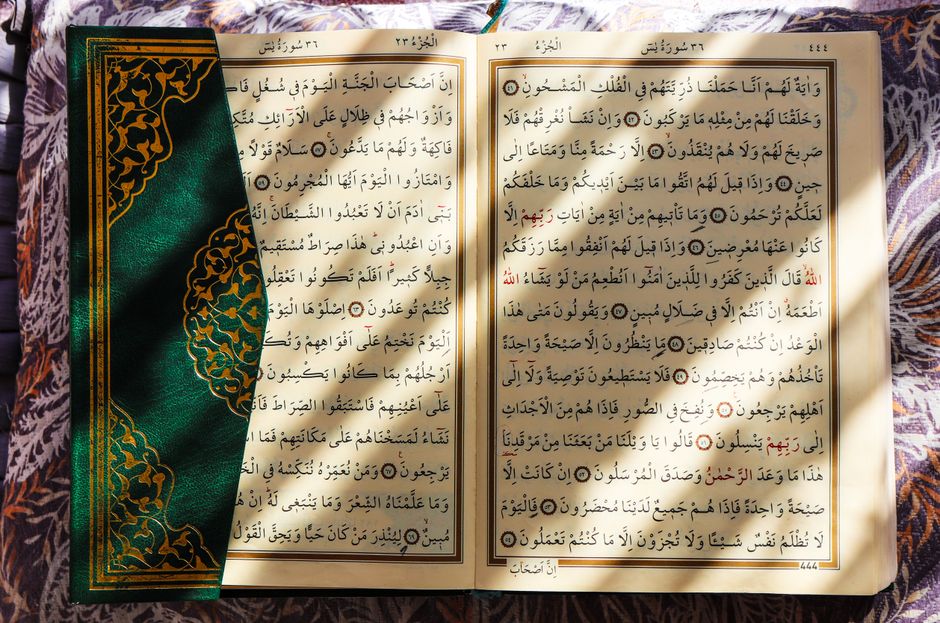
Unlike the Bible, which Christians understand as written by inspired human authors, Muslims believe the Quran is the literal word of God, dictated to Muhammad through Gabriel. Muhammad is the messenger; the Quran is the message.
This distinction matters for understanding Islamic theology. Muhammad is revered but not divine. He explicitly rejected any claims of divinity and insisted he was a mortal human being who happened to be chosen for prophecy. The Quran itself commands: “Say: I am only a mortal like you; it is revealed to me that your God is One God.”
The Quran covers theology, law, history, ethics, and spirituality. It retells stories from Jewish and Christian tradition—Abraham, Moses, Jesus, Mary—while presenting them within an Islamic framework. It addresses specific situations Muhammad faced while also laying down universal principles.
For Muslims, the Quran’s Arabic language is itself sacred. Translations are considered interpretations, not the actual Quran. This has preserved the text’s original language with remarkable fidelity across fourteen centuries.
Muhammad’s Character as Teaching
Beyond specific doctrines, Muslims are taught to emulate Muhammad’s character. His sayings and actions, collected in literature called Hadith, provide detailed guidance on everything from personal hygiene to business ethics.
What emerges from these accounts is a complex human being: tender with children, patient with ignorant questions, firm against injustice, forgiving toward personal enemies. He reportedly mended his own clothes, helped with household chores, and disliked excessive formality.
He was also fully human in his struggles. He experienced grief, doubt, and fear. He made decisions that he later reconsidered. He got angry. He had favorites among his companions and disagreements with his wives. Islamic tradition doesn’t hide these human dimensions but embraces them.
Part Five: The Legacy — Muhammad’s Lasting Impact
The Immediate Aftermath
Muhammad’s death plunged the community into crisis. He had left no clear succession plan. Was leadership inherited? Elected? Based on closeness to Muhammad? Different answers to these questions would eventually split Islam into Sunni and Shia branches.
Abu Bakr, one of Muhammad’s earliest companions, was chosen as the first caliph (successor). He and the subsequent caliphs expanded the Islamic state with stunning speed. Within a century of Muhammad’s death, Muslim armies had conquered from Spain to Central Asia. The Persian Empire fell completely. The Byzantine Empire lost its Middle Eastern and North African territories.
The Civilization That Followed
The Islamic civilization that emerged was among history’s greatest. During Europe’s medieval period, Muslim scholars preserved and advanced Greek philosophy, developed algebra and algorithms, made major discoveries in medicine and astronomy, and created architectural wonders that still stand.
This wasn’t despite Islam but connected to it. The Quran repeatedly commands believers to reflect on creation, study nature, and seek knowledge. Early Muslims understood religious devotion and scientific inquiry as complementary, not conflicting.
Cities like Baghdad, Cordoba, and Cairo became centers of learning that attracted scholars of all faiths. The translation movements that preserved Aristotle and Plato for European rediscovery happened in Islamic libraries. The numerals we call “Arabic” (though originally Indian) spread through Muslim mathematicians.
Modern Islam
Today, Islam encompasses enormous diversity. Nearly two billion people across every continent practice this faith, from Indonesian rice farmers to American doctors, from Nigerian traders to European engineers.
The religion has produced reformers and reactionaries, mystics and militants, scholars and charlatans—like any major religion. Debates about how to understand and apply Muhammad’s teachings in modern contexts continue vigorously within Muslim communities. What does Islam say about democracy? Gender equality? Religious pluralism? Muslims disagree passionately.
Muhammad himself cannot resolve these debates. He lived in seventh-century Arabia and addressed seventh-century problems. The principles he taught require interpretation for circumstances he never imagined. That interpretive work—complex, contested, ongoing—is the living legacy of his message.
Part Six: Understanding Muhammad Today
Beyond the Controversy
In the modern West, Muhammad often appears primarily in contexts of controversy—terrorism debates, free speech conflicts, cultural clashes. This distorted lens makes genuine understanding difficult.
The Muhammad that 1.8 billion Muslims revere isn’t a figure of violence or repression but a model of moral excellence. When Muslims say “peace be upon him” after his name, they express love for someone they consider the best human being who ever lived. Understanding this devotion—even if you don’t share it—is essential for meaningful dialogue in our interconnected world.
At the same time, critical historical engagement shouldn’t be off-limits. Muhammad was a human being who lived in a specific time and place, and honest inquiry requires acknowledging dimensions of his life that modern readers may find troubling. Scholarly examination of early Islamic sources, like scholarship about any historical figure, continues to evolve.
What Can Anyone Learn?
Even setting aside religious belief, Muhammad’s life offers lessons worth considering:
On Perseverance: Thirteen years of rejection in Mecca before his message found receptive soil. Repeated losses, betrayals, and near-defeats. Success came not through instant breakthrough but through relentless persistence.
On Leadership: Building a community from scratch, transforming enemies into allies, establishing systems that outlasted his death. Muhammad was a remarkably effective leader by any measure.
On Mercy: Pardoning Mecca after years of persecution. Forgiving personal enemies. Emphasizing compassion in nearly every context. His reputation for mercy was central to his appeal.
On Questioning: A man who retreated to caves to think about life’s big questions, dissatisfied with the answers his society provided. The willingness to question inherited assumptions began everything.
Conclusion: A Life That Still Speaks
Muhammad’s biography spans sixty-three years. His prophetic mission lasted twenty-three. From that relatively brief window came a religion, a civilization, and a legacy that shapes our world to this day.
Was he a prophet of God or a remarkable human leader? That question depends on faith, and this guide isn’t here to answer it for you. What seems clear historically is that Muhammad was a genuine visionary who believed absolutely in his mission and lived accordingly.
His message of one God, human equality, social justice, and moral accountability transformed Arabia and then reached far beyond. The civilization his followers built preserved classical learning, advanced human knowledge, and created artistic achievements of lasting beauty. The religious tradition he founded continues to provide meaning, community, and moral guidance for nearly two billion people.
Understanding Muhammad—beyond caricature, beyond controversy, beyond uncritical devotion—matters for anyone seeking to understand our world. His history, message, and teachings remain living forces, debated and interpreted, applied and contested, in every corner of the globe.
Whatever your own beliefs, engaging honestly with this history enriches understanding of human civilization itself. And perhaps, in Muhammad’s own emphasis on seeking knowledge and reflecting deeply, there’s wisdom for anyone willing to listen.
📚 Free PDF Book Download
Get our comprehensive guide on spirituality and religious understanding
Download Free PDF Book📧 Get More Insights Like This
Join thousands of readers who receive evidence-based personal development tips directly in their inbox.
🌟 Start Your Transformation Today
Ready to take the next step in your personal development journey?
Learn More About Us Browse All Articles